

Adapting to climate change: how can companies better prepare for extreme weather events?

The summer of 2026 was particularly turbulent in terms of extreme weather events : recurring heatwaves, nationwide drought, record-breaking wildfires… Events that were once extraordinary now seem to be quietly carving out a place in our new normal. Events that individuals and businesses must adapt to as quickly as possible if they want to survive tomorrow.
Climate change adaptation is often overlooked by companies in their CSR strategies, yet it is a key consideration for understanding climate vulnerability and ensuring resilience.
What is climate change adaptation?
The difference between climate change adaptation and mitigation
Climate change adaptation encompasses all processes, initiatives, and actions that aim to adjust to climate change as it stands today (adapting to consequences visible now) and to the impacts expected in the future.
For a business, this means implement targeted actions or make structural changes to ensure its long-term viability. This subject is largely neglected by the economic sphere, as well as the political sphere, which generally react in a state of urgency ("quick, turn on the AC") instead of anticipating these extreme events to prepare for them (but who could have predicted...?).
Climate change adaptation is generally associated with climate change mitigation : the processes and initiatives put in place to reduce our climate impact, i.e., our greenhouse gas emissions. Mitigation is often the flagship topic for companies, which commit to emission reduction pathways in order to limit global warming to 1.5°C as provided for by the Paris Agreement.
Many ESG frameworks such as the CSRD suggest that companies consider climate change adaptation on an equal footing with mitigation; however, there is still a great deal of awareness-raising to be done for this subject to become a priority.
Vulnerability to climate change: what are physical risks and transition risks?
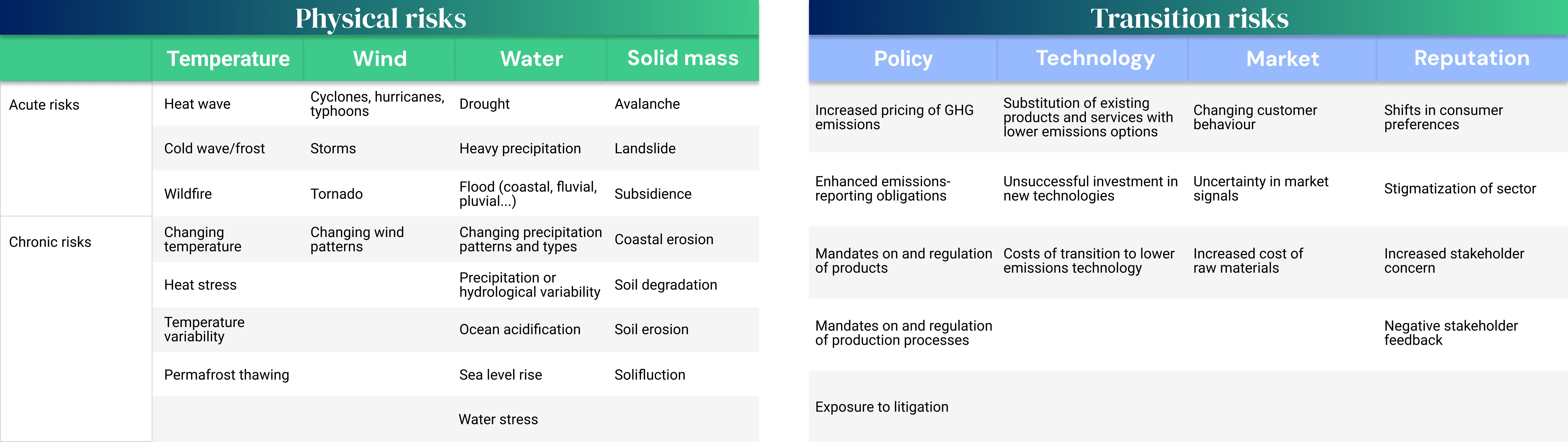
In order to identify the actions to implement to adapt to climate change, companies must identify the climate risks to which they are or will be vulnerable. These risks are divided into physical risks and transition risks.
The physical risks are the risks associated with specific climate events (acute risks) or long-term changes in climate patterns (chronic risks).
- Acute physical risks : storms, floods, fires, heatwaves…
- Chronic physical risks : rising sea levels, water scarcity, declining soil productivity…
Transition risks are, as the name suggests, the risks associated with the transition to a sustainable economy. These typically involve risks related to policy, legal, or technological changes, as well as reputational risks.
Once these risks have been identified for your company, you can define action plans to address them. Many frameworks have developed comprehensive lists of physical and transition risk examples that you can use as a reference.
Concrete examples of climate change adaptation measures
To understand what climate change adaptation looks like in practice for companies around the world, here are some concrete and inspiring examples.
- Dealing with heat like “hot” countries : we need to adapt our working hours to cope with heatwaves—starting earlier during cooler hours, reducing workloads to give bodies more time to rest…
- Dealing with rising sea levels like EDF : anticipating a rise in sea levels in the coming decades, EDF is adapting its new nuclear power plants, notably by setting installations further back from the coastline or by building seawalls.
- Dealing with heatwaves like Eurostar : Eurostar recently announced an order for new trains capable of operating in temperatures up to 55°C as a precaution against future heatwaves.
- Dealing with resource depletion like Carsat : to reduce its energy dependence, Carsat is building its new headquarters based on bioclimatic architectural principles, ensuring a constant indoor temperature of 24°C in the dead of winter and during heatwaves alike, without the need for heating or air conditioning.
There are many examples of companies and local authorities preparing for climate change, forming a kaleidoscope of initiatives to draw inspiration from. It is up to you to determine what form this adaptation should take within your company.
What are the 3 steps to prepare my company for climate change adaptation?
To adapt your company to climate change, you can follow these 3 steps:
- Map your climate change vulnerabilities
- Define your climate change adaptation strategy
- Reduce your climate impact
Step 1: Map your vulnerabilities
Mapping your vulnerabilities means identifying the physical and transition risks that climate change poses to your business. This is the stage where you must imagine what your company would look like under different scenarios : how would your company function in a world without oil? what would be the impact of heatwaves 100 days a year on your productivity? to what extent can you absorb a rise in raw material prices? etc.
Various methodologies exist to structure your mapping:
- double materiality assessment : an internationally recognized methodology that covers not only climate risks but also the full range of environmental, social, and governance risks
- the climate vulnerability assessment : territory-focused, this methodology supported by ADEME anchors the specific risks to your geography
- the environmental impact assessment : funded by BPI, this assessment allows you to quickly identify your environmental impacts and risks
Step 2: Define your climate change adaptation strategy
Once your risks have been identified, it is time to implement your mitigation plan and define your adaptation strategy. We recommend distinguishing between immediate actions, for which you need to allocate a budget quickly, and long-term actions that require investment, in order to best organize your strategy.
These strategies are unique to each company, but the themes covered are common:
- What resources does my business depend on? How can I reduce my dependence on these resources and increase my autonomy?
- How can I transform my business model to operate in a sustainable economy?
- What are the emergency plans to be defined to prepare teams for extreme events?
Step 3: Reduce your climate impact
Finally, mitigation remains necessary to limit the damage : the current trajectory is leading us toward a world that is 3°C to 4°C warmer by 2100; it is high time to reverse the trend to minimize the inevitable negative consequences of our emissions.
To do this, if you haven't already, you can conduct a carbon footprint assessment of your business, and subsequently define an emissions reduction trajectory compatible with the Paris Agreement.
Conclusion
If the climate events of summer 2026 revealed one thing, it is the lack of preparation among individuals, policymakers, and businesses for the climate events associated with a rapidly warming world. It is high time that the subject of climate change adaptation be tackled head-on in order to prepare for a challenging climate.
At Kiosk, we support you throughout the implementation of your climate change adaptation strategy and your mitigation plan: from identifying your risks to conducting your carbon footprint assessment, and defining your adaptation measures. Contact us!
Sources
https://www.edf.fr/sites/groupe/files/2024-07/edfgroup_adaptation-au-climat_20240712_fr.pdf
Discover more articles
Dive into the heart of the subjects
Which actions should I highlight in my CSRD?
.png)
Adapting to climate change: how can companies better prepare for extreme weather events?
.png)

Scope 3 Carbon Footprint: how to prioritize, refine, and collect your data without getting overwhelmed?

FAQs
Find answers to common questions about CSRD and Kiosk
The CSRD or Corporate Sustainability Reporting Directive is the new European directive which aims to impose and better regulate corporate sustainability reports.
It makes companies more transparent, with standardized ESG reporting standards called ESRS (European Sustainability Reporting Standards)
The application of the Corporate Sustainability Reporting Directive is progressive. Here is a summary table.
| Effective year | Businesses impacted | Standard |
|---|---|---|
| 2025 (over the financial year 2024) | Listed companies with more than 500 employees | ESRS |
| 2026 (sur l’exercice 2025) | Autres grandes entreprises de plus de 1000 salariés | ESRS |
| 2026 (over the financial year 2025) | Businesses that meet two out of three criteria: | VS (ex VSME) |
| 2027 (over the year 2026) | SMEs listed on the stock exchange | VS (ex VSME) |
| 2029 (over the fiscal year 2028) | Non-European companies with at least €150M in turnover on the European market | ESRS |
Want to know when your business is impacted? Use our regulatory monitoring tool to find out.
The "omnibus" bill is a recent initiative by the European Commission aimed at reducing the scope of the CSRD directive. It proposes, in particular, to raise the application thresholds: only companies with more than 1,000 employees would be affected, compared to 250 previously.
It promotes the adoption of the VS (ex-VSME) framework to reduce the reporting burden on SMEs and mid-cap companies.
The VS (Voluntary Standard) (ex-VSME, Voluntary Sustainability Reporting Standard) is a voluntary European standard designed to help unlisted small and medium-sized enterprises (SMEs) structure and communicate their sustainability initiatives. Developed by EFRAG, this standard offers a lighter framework compared to ESRS standards, covering ESG aspects. It allows in particular to:
- Harmonizing sustainable reporting practices in Europe
- Facilitate the response to the expectations of business partners
- Improving access to responsible financing
It aims to harmonize sustainable reporting practices, facilitate meeting the expectations of business partners, and improve access to responsible financing. Although not mandatory, adopting VS (ex-VSME) allows SMEs to demonstrate their commitment to sustainability and anticipate future regulatory developments.
- Complete the preliminary steps for the CSRD
These steps are dual materiality analysis and gap analysis. They will help you understand the material issues, impacts, risks, and opportunities for your business. They will also allow you to create a roadmap based on what you have already achieved.
Check out our article on double materiality here.
- Compile your data and produce your indicators
Centralizing sustainability data is essential for your compliance, particularly to facilitate understanding and consistency when producing quantitative indicators.
- Produce your detailed report in XHTML format with XBRL tags
Thanks to its tagging and visualization technologies, Kiosk guarantees a very high level of consistency.
Find our article on XBRL tagging here .
- Audit your data
At the end of these steps, your sustainability report is ready to be audited by an Independent Third Party Organization (ITO).
Kiosk supports your compliance journey throughout this process. For more information on these steps, we invite you to contact our team.
CSRD compliance requires companies to:
- understanding the 12 ESRS and 82 disclosure requirements
- the collection of more than 1,000 data points
- the calculation of 50-147 quantitative indicators
- tagging 4,000 items in the final report
Kiosk is a software that allows companies to save 5 months on the preparation of their CSRD report by automating the most time-consuming steps.
- First of all, the security of your data is our priority.
- All data is stored in France, in Paris, via our French hosting provider.
- During transit, your data is encrypted in SSL/TLS from the user's browser to our servers guaranteeing the security of communications.
- Data is also encrypted at rest, both on the database and on file storage, protecting the data in the event of a leak or attempted theft.
- Kiosk's technical teams are the only ones who can access your data.
- Kiosk is in the process of ISO27001 certification.
- Our technical support is available 24/7.