
Measure your carbon footprint. Then drive it down.
Our carbon consultants support you every step of the way, from defining your reporting boundaries to building your reduction plan.







Why measure your emissions now
A carbon footprint is no longer just a compliance exercise. It is the foundation of your climate strategy: the data your customers, investors and regulators expect from you, and the data that shows you where to act first.
- Meet your obligations
BEGES for organizations in scope, ESRS E1 under the CSRD, the VS standard for SMEs. All of these requirements rely on the same underlying emissions data. - Deliver on your commercial commitments
Procurement questionnaires, tenders, EcoVadis, CDP, requests from your key accounts. Without an up-to-date footprint, your answers are guesswork. - Uncover cost-saving opportunities
Energy, purchasing, freight, business travel. Your highest-emitting items are often your biggest cost centers too. - Build a realistic reduction pathway
A footprint alone doesn't reduce anything. The value comes from repeating the exercise, comparing year over year and tracking your actions to hit your targets.
Already completed a carbon footprint?
We import your past assessments into the platform to restore year-over-year comparability, strengthen your most uncertain emission items and start from a usable history. You keep your base year and gain full traceability.
Everything you need,
in one place
without digging out last year's spreadsheet.

Structure your organization by legal entities, subsidiaries, sites and reporting boundaries, and define each contributor's role. Everyone only sees what's relevant to them.

API connections, standardized files, questionnaires sent to your contributors or manual entry. Each data source comes in through the channel that's easiest for it.

Your data is automatically matched to reference databases, and you can add your own supplier-specific factors whenever you have them.

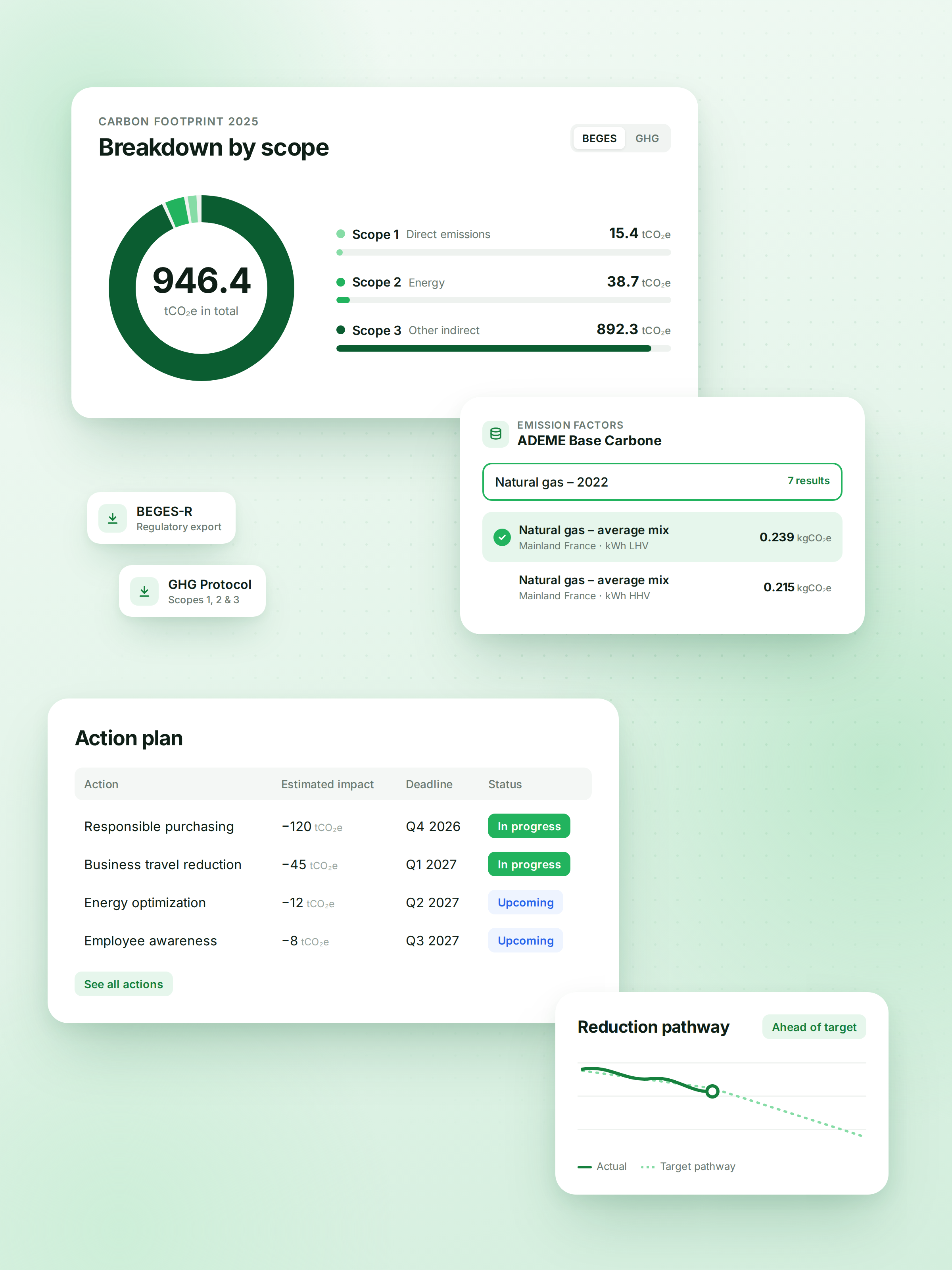
Emissions calculated across Scopes 1, 2 and 3, broken down by category, entity and site, with uncertainty analysis.

Deliverables compliant with the BEGES format and the GHG Protocol, ready to reuse for your CSRD (ESRS E1) or Voluntary Standard (VS) reporting.

Model your reduction scenarios, assign each action to an owner, track progress and compare results year over year.
A structured approach
Organizational and operational boundaries, base year, applicable requirements, expected level of accuracy.
This step determines the comparability of every assessment that follows.
Data collection campaigns managed in the platform, automated reminders, consistency checks and supporting documents stored alongside the data.
Every data point stays linked to its source.
Smart emission factor suggestions, results by scope and category, uncertainty analysis, and identification of significant emission categories and priority reduction levers.
A quantified action plan with KPIs, owners and deadlines, followed by an updated footprint to measure the real impact of the actions taken.
The right tool,
backed by real expertise

Does the BEGES requirement apply to you?

What our clients say

Leïla Belbachir
Head of CSR
Altavia
Marketting

Tolga Coskun
Director of Sustainable Urban Development
Hectare
Urban Development
.png)
Juliette Prezelin
CFO
NEO2
Ingeneering

See the platform in action
and what you can get out of it from your very first assessment.
FAQs
The BEGES is a greenhouse gas emissions assessment required of certain organizations under the French Environmental Code. It must follow ADEME's regulatory methodology, include a transition plan and be published on the ADEME platform.
The Bilan Carbone® is a methodology for measuring an organization's direct and indirect emissions, identifying its main emission sources and building a reduction strategy suited to its business. A Bilan Carbone® can also serve as the basis for a compliant BEGES, ready to be submitted on the ADEME platform.
In mainland France, private-sector legal entities with 500 or more employees must complete a BEGES along with a transition plan. The threshold is 250 employees in the French overseas departments and regions, and the assessment must be updated every four years. Public-sector legal entities are also in scope: the French State, regions, departments, municipalities with more than 50,000 inhabitants and public institutions with more than 250 employees, with an update required every three years. Failure to complete or submit the assessment can result in a fine of up to €50,000, rising to €100,000 for repeat offenses.
A comprehensive carbon assessment covers direct emissions (Scope 1), energy-related emissions (Scope 2) and other indirect emissions (Scope 3: purchases, freight, business travel, capital goods, and the use and end-of-life of products).
For a regulatory BEGES, companies in scope must at least include Scopes 1 and 2, as well as significant indirect Scope 3 emissions where relevant.
For other organizations, Scope 3 isn't always mandatory, but it is strongly recommended: that's often where most of the footprint and the reduction levers lie.
The data typically includes electricity and fuel consumption, purchases of materials and services, distances traveled, freight transport, business travel, employee commuting, waste, capital goods and product sales.
The quality of the assessment depends as much on reliable data as on the relevance of the assumptions and emission factors used. That's exactly what Kiosk lets you trace: every data point stays linked to its source and supporting documents.
The footprint identifies your main emission sources and priority levers. These results are then translated into quantified targets, operational actions, budgets and tracking KPIs.
The pathway can be aligned with national and European climate targets, sector-specific decarbonization pathways, or a framework such as SBTi. It should also distinguish between reductions the company can achieve directly, external dependencies, and actions to roll out over the short, medium and long term.
A platform lets you centralize your data, structure your data collection campaigns, store supporting documents and recalculate emissions regularly. It makes it easier to compare years, sites or entities, track action plans and prepare the exports needed for both BEGES and ESG reporting.
The tool doesn't replace the methodological expertise needed to define the boundaries, analyze the results and build a credible pathway: at Kiosk, the two go hand in hand.
It depends on the size of the company and the complexity of its organization. On average, allow about 3 months from project kickoff to the final results presentation.