


Since 2024, the CSRD requires European companies to produce a standardized sustainability report covering all dimensions of ESG (environment, social, governance). The level of requisites is comparable to financial reporting, both in terms of rigor and granularity.
Gathering data to get started with conformity with the CSRD is the first obstacle for the companies concerned. The ESRS require the completion of several hundreds of metrics. Information is scattered throughout the organization and there are many people who need to be mobilized. Without a method, the data collection quickly becomes time-consuming, complex and expensive, to the point of affecting the reliability of the report produced.
This article presents the three steps to structure this decisive phase and enable the companies concerned to reach the conformity : mapping, training of referees and centralization.
1. Data collection: the CSRD reporting stage that should (especially) not be overlooked
1.1. Over 1,000 data points scattered across the company
The ESRS require to fill in hundreds of data Points : GHG emissions, power consumption, biodiversity, social policies, pay differentials, practices of governance...
This data is rarely centralized. They are found in the financial, HR, purchasing, operations departments, and sometimes with external partners of the value chain. Without mapping, teams CSR waste time locating data that they sometimes don't know exists or owns.
To discover the datapoints of the new ESRS, go to hither.
1.2. A collective exercise that requires rigor
The extra-financial reporting differs from financial reporting in one key way: it mobilizes numerous contributors in the company. Everyone has some of the data, but not all have the same knowledge of requisites of the CSRD.
Without foresight, problems appear at the time of auditing the conformity. Auditors expect reliable, traceable and documented data (1). When this is not the case, the consequences are direct:
- Repeated back and forth between auditors and internal teams to justify or correct figures
- Inconsistencies between indicators which weaken the credibility of the report
- A risk of non-compliance on a regulatory and reputational level
- Wasted time that a structured process would have avoided
Structuring its data collection upstream is therefore a real prerequisite. This is what makes it possible to transform a mandatory regulatory process in a fluid and controlled process, reproducible without friction.
2. How to structure your collection in 3 steps
2.1. Step 1: Map data and identify referrers
The first step is a work of mapping. It is a question of identifying which metrics are required in accordance with its double materiality, to locate this data in the organization and to designate the persons responsible.
It is also time to define collection methods adapted to each type of data. An HR manager will not provide their data in the same way as an ERP or a supplier of supply chain.
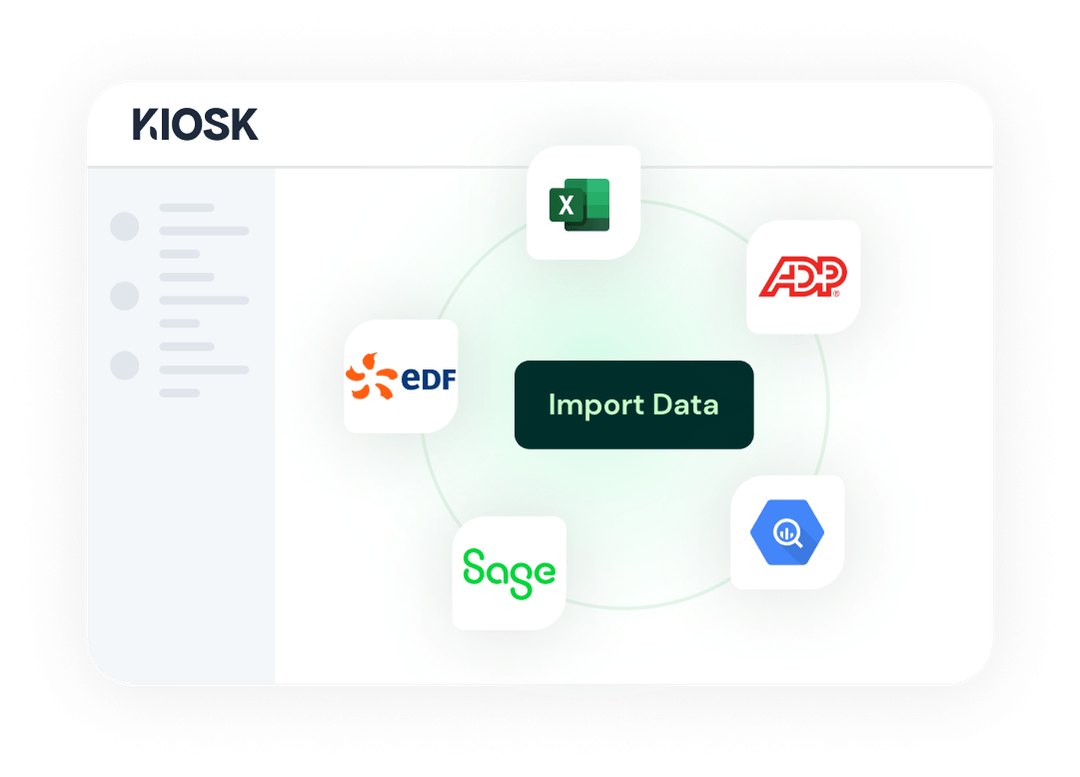
In practice, four collection channels coexist. This is the approach adopted by Kiosk, which natively integrates these four complementary methods:
- API connections : to automatically synchronize data from your existing tools (HRIS, ERP, accounting...)
- Standardized files : when ESG data already exists in the form of structured files
- Surveys : to solicit internal or external stakeholders who hold the data
- Manual entry : for specific or qualitative data that does not exist in any system
Each venture and each sector of activity has its constraints. A robust process relies on the ability to combine these channels.
2.2. Step 2: Train referees to avoid back and forth
Even when the right contacts have been appointed and a spreadsheet sent to them, the data collected may prove to be unusable: bad format, inadequate scope or missing information.
Referrers are operational staff who do not necessarily know the ESRS standards on your fingertips. Asking them to fill in an indicator without prior explanation does not always work.
One short and condensed training can solve this problem. It must cover three points: what is expected (what indicator, what scope), how to provide it (format, evidence) and why it is necessary (issues of compliance, auditing and internal control).
The gain is immediate: more correct data from the first time you enter it and fewer reminders. The referees better understand their role in the process, which reinforces their commitment and the quality of the contributions over time.
At Kiosk, a support phase dedicated to the training of referees is systematically integrated into the collection process, in order to guarantee the quality of the data from the first reporting cycle. (2)
2.3. Step 3: Centralize collection to ensure data reliability
The mapping is done, the referents are trained. Now the data needs to get to the right place, in the right format.
Without a centralized space, collection is scattered between Excel files, cross-emails and shared drives. The consequences: duplicates, contradictory versions and data that could not be found during the audit. (3)
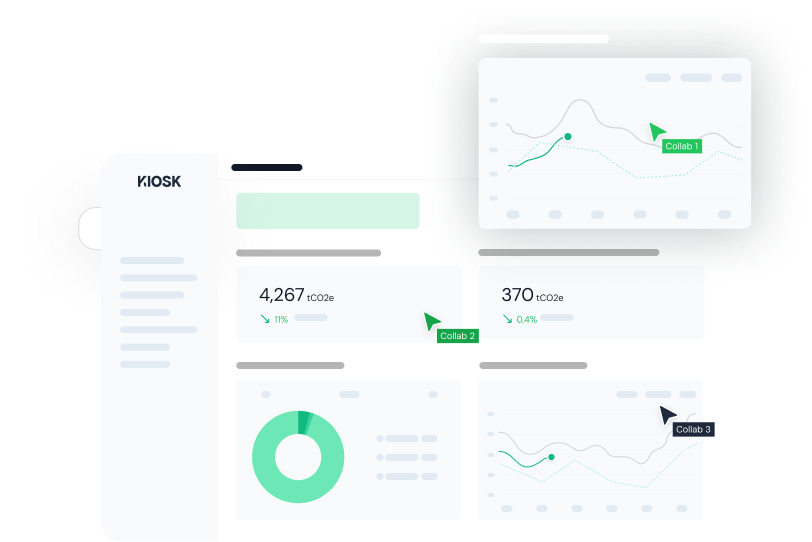
One dedicated tool makes it possible to monitor progress in real time, to contact contributors when necessary and to control the quality of the data entered. This is the role of a platform like Kiosk, which centralizes the process and ensures the traceability of each data until it is verified by the auditors.
Centralizing collection is what makes the difference between a reliable extra-financial report and a report that we spend months correcting.
Conclusion
The data collection determines the quality of the entire CSRD reporting. A well-written report reduces friction during the audit and reinforces the credibility of the process. Mapping your needs, training your referees and centralizing the process makes it possible to move from an exercise undergone to a controlled process.
Find out how Kiosk can help you make this reporting stage more reliable, book a demo.
Sourcing
- The H2A guidelines: https://h2a-france.org/publications/la-h2a-publie-les-lignes-directrices-relatives-a-la-mission-de-certification-des-informations-en-matiere-de-durabilite-et-des-inform
- Training: https://www.meetkiosk.com/articles/csrd-quelles-formations-realiser-pour-mon-rapport
- KPMG 2025 study: https://kpmg.com/fr/fr/insights/information-esg/benchmark-projets-csrd-2024.html - 65% of companies report major difficulties in collecting data beforehand, while 71% of them still use traditional office solutions for their collection, and only 24% have adopted a dedicated tool.
Discover more articles
Dive into the heart of the subjects

Which actions should I highlight in my CSRD?
.png)

Adapting to climate change: how can companies better prepare for extreme weather events?
.png)

Scope 3 Carbon Footprint: how to prioritize, refine, and collect your data without getting overwhelmed?

FAQs
Find answers to common questions about CSRD and Kiosk
The CSRD or Corporate Sustainability Reporting Directive is the new European directive which aims to impose and better regulate corporate sustainability reports.
It makes companies more transparent, with standardized ESG reporting standards called ESRS (European Sustainability Reporting Standards)
The application of the Corporate Sustainability Reporting Directive is progressive. Here is a summary table.
| Effective year | Businesses impacted | Standard |
|---|---|---|
| 2025 (over the financial year 2024) | Listed companies with more than 500 employees | ESRS |
| 2026 (sur l’exercice 2025) | Autres grandes entreprises de plus de 1000 salariés | ESRS |
| 2026 (over the financial year 2025) | Businesses that meet two out of three criteria: | VS (ex VSME) |
| 2027 (over the year 2026) | SMEs listed on the stock exchange | VS (ex VSME) |
| 2029 (over the fiscal year 2028) | Non-European companies with at least €150M in turnover on the European market | ESRS |
Want to know when your business is impacted? Use our regulatory monitoring tool to find out.
The "omnibus" bill is a recent initiative by the European Commission aimed at reducing the scope of the CSRD directive. It proposes, in particular, to raise the application thresholds: only companies with more than 1,000 employees would be affected, compared to 250 previously.
It promotes the adoption of the VS (ex-VSME) framework to reduce the reporting burden on SMEs and mid-cap companies.
The VS (Voluntary Standard) (ex-VSME, Voluntary Sustainability Reporting Standard) is a voluntary European standard designed to help unlisted small and medium-sized enterprises (SMEs) structure and communicate their sustainability initiatives. Developed by EFRAG, this standard offers a lighter framework compared to ESRS standards, covering ESG aspects. It allows in particular to:
- Harmonizing sustainable reporting practices in Europe
- Facilitate the response to the expectations of business partners
- Improving access to responsible financing
It aims to harmonize sustainable reporting practices, facilitate meeting the expectations of business partners, and improve access to responsible financing. Although not mandatory, adopting VS (ex-VSME) allows SMEs to demonstrate their commitment to sustainability and anticipate future regulatory developments.
- Complete the preliminary steps for the CSRD
These steps are dual materiality analysis and gap analysis. They will help you understand the material issues, impacts, risks, and opportunities for your business. They will also allow you to create a roadmap based on what you have already achieved.
Check out our article on double materiality here.
- Compile your data and produce your indicators
Centralizing sustainability data is essential for your compliance, particularly to facilitate understanding and consistency when producing quantitative indicators.
- Produce your detailed report in XHTML format with XBRL tags
Thanks to its tagging and visualization technologies, Kiosk guarantees a very high level of consistency.
Find our article on XBRL tagging here .
- Audit your data
At the end of these steps, your sustainability report is ready to be audited by an Independent Third Party Organization (ITO).
Kiosk supports your compliance journey throughout this process. For more information on these steps, we invite you to contact our team.
CSRD compliance requires companies to:
- understanding the 12 ESRS and 82 disclosure requirements
- the collection of more than 1,000 data points
- the calculation of 50-147 quantitative indicators
- tagging 4,000 items in the final report
Kiosk is a software that allows companies to save 5 months on the preparation of their CSRD report by automating the most time-consuming steps.
- First of all, the security of your data is our priority.
- All data is stored in France, in Paris, via our French hosting provider.
- During transit, your data is encrypted in SSL/TLS from the user's browser to our servers guaranteeing the security of communications.
- Data is also encrypted at rest, both on the database and on file storage, protecting the data in the event of a leak or attempted theft.
- Kiosk's technical teams are the only ones who can access your data.
- Kiosk is in the process of ISO27001 certification.
- Our technical support is available 24/7.